Today’s post comes from guest writer Kaya Ellis of Sudoked, a Sudoku trainer site. It’s a hands-on look at one of the most useful moves in Sudoku, with two worked examples and a practice position for you to try. If you’d like the background first, our earlier post Naked Singles vs. Hidden Singles explains the difference between the two.
You have checked an empty Sudoku cell and found three possible numbers. Nothing seems certain, so you move on. But that cell might already have a definite answer. To find it, you need to look at the row, column or box around it.
A hidden single appears when a missing number has only one possible position within a row, column or 3×3 box. The cell may still have several candidates written inside it. What matters is that one of those numbers cannot go anywhere else in that group.
Two Ways to Find a Single
In standard Sudoku, each row, column and 3×3 box must contain the numbers 1 to 9 exactly once. A candidate is a number that does not conflict with the digits already placed in a cell’s row, column or box.
There are two useful questions to ask:
- Naked single: “Which number can go in this cell?” Only one candidate remains.
- Hidden single: “Where can this number go in this row, column or box?” Only one cell remains.
For example, a cell with candidates 2, 5 and 8 is not a naked single. But if it is the only cell in its row that can hold 5, it must be 5. The other candidates can be erased.
A Worked Example: Look for 7 in the Bottom-Left Box
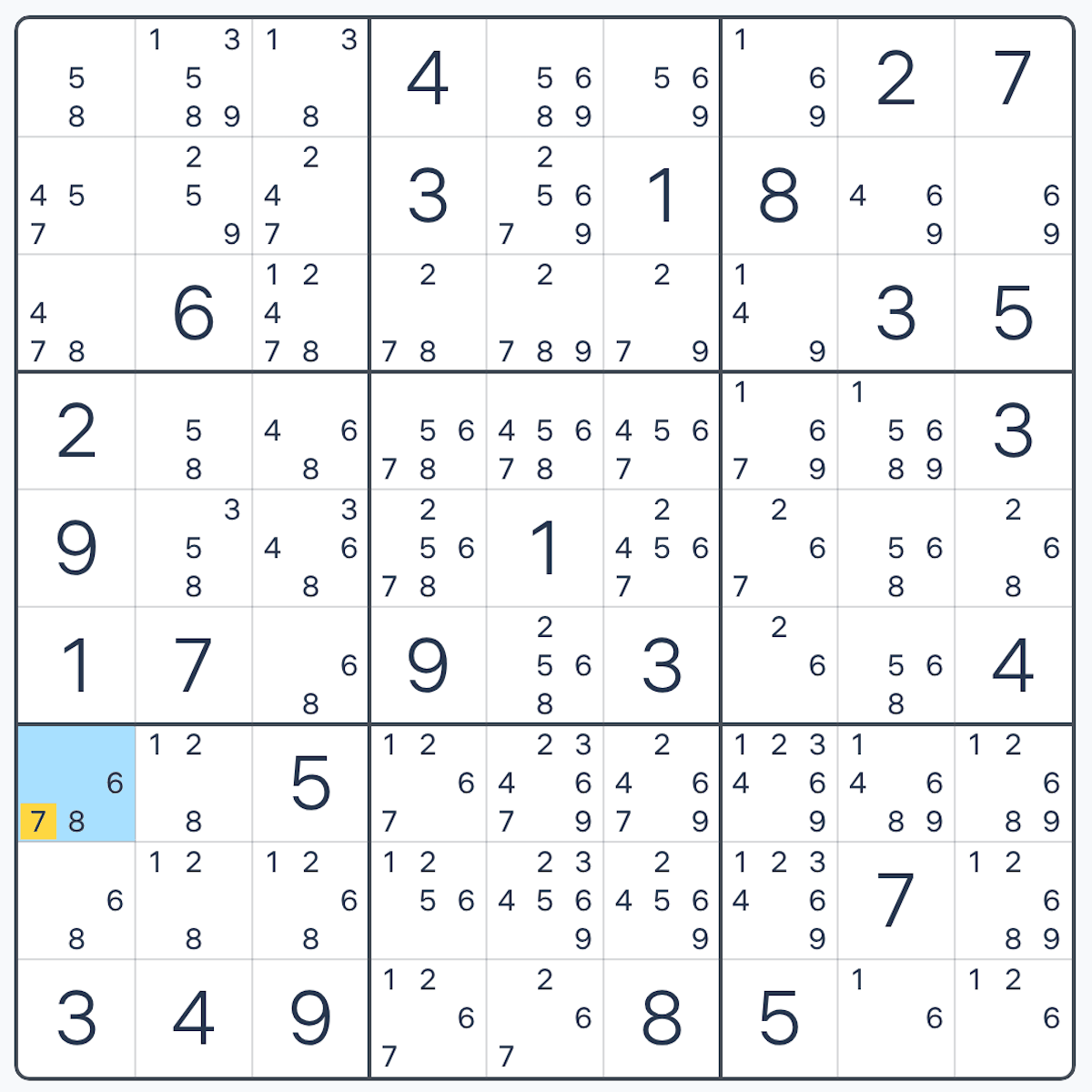
This box is missing 1, 2, 6, 7 and 8. Let’s focus on 7 rather than trying to solve every empty cell.
Only the highlighted cell contains a candidate 7, so that cell must be 7.
A Scanning Routine You Can Reuse
You can reach the same conclusion without writing all those pencil marks. Consider the following example.
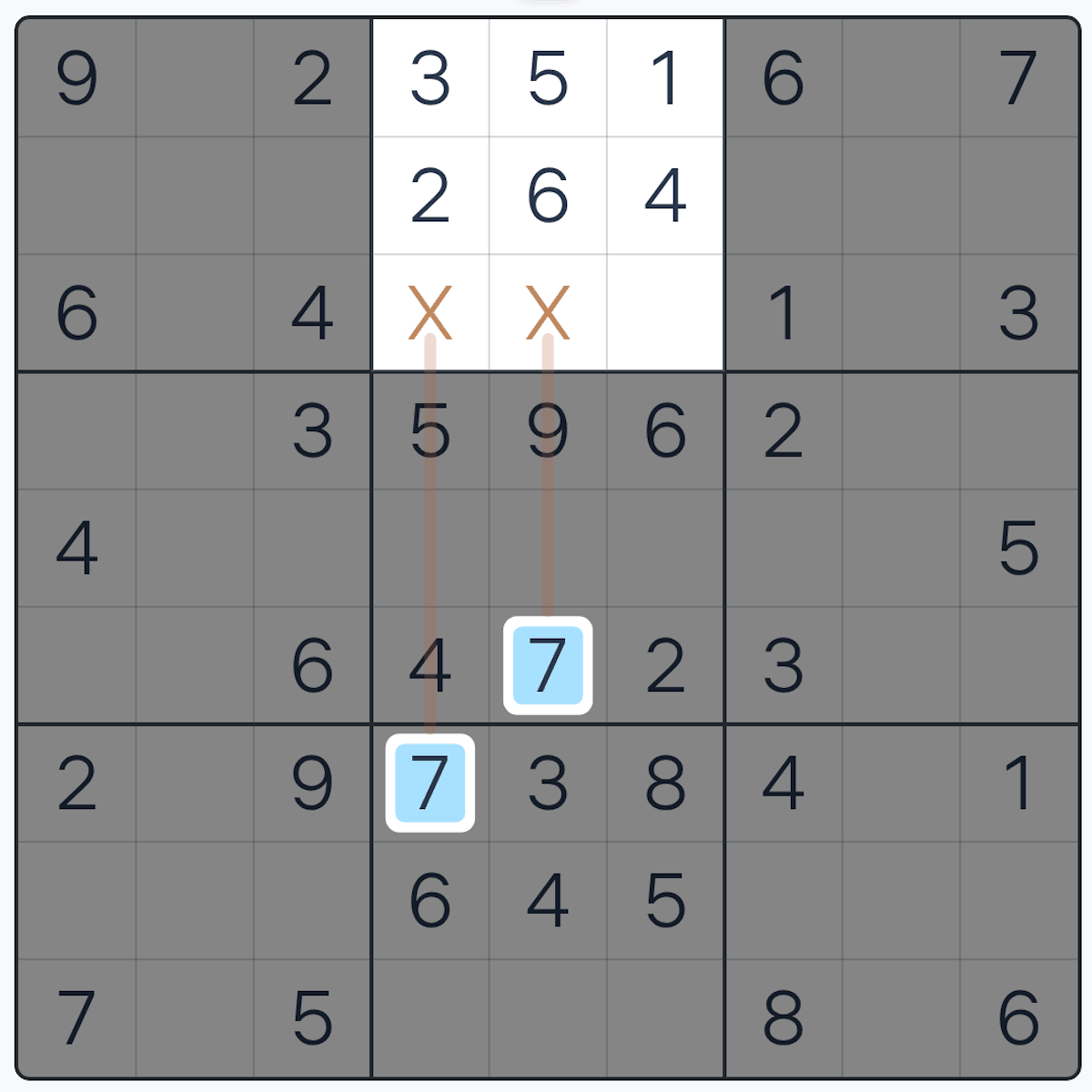
As you can see, 7 has only one possible position in the highlighted 3×3 box. Every other cell is either already occupied or ruled out by a 7 in the same column.
The general routine is simple:
- Choose a row, column or box and identify its missing numbers.
- Pick one of them, then check each empty cell against the digits already placed in its row, column and box.
- If exactly one cell can hold the number, place it. If two or more cells can hold it, leave them open and try another number. If no cell can hold it, check for an earlier mistake or a missed candidate.
- After placing a number, update the affected pencil marks. One placement can reveal another single nearby.
You do not need a fully pencilled grid to use this technique. Scanning one number at a time is enough, provided you check every empty cell in the group you have chosen.
Practice Position: Can You Spot the Hidden Single?
It is easy to recognise a hidden single once someone points it out. Finding one yourself, in the middle of a puzzle, takes a little more patience. This short exercise gives you a chance to practise the same kind of scanning you would use in a real game.
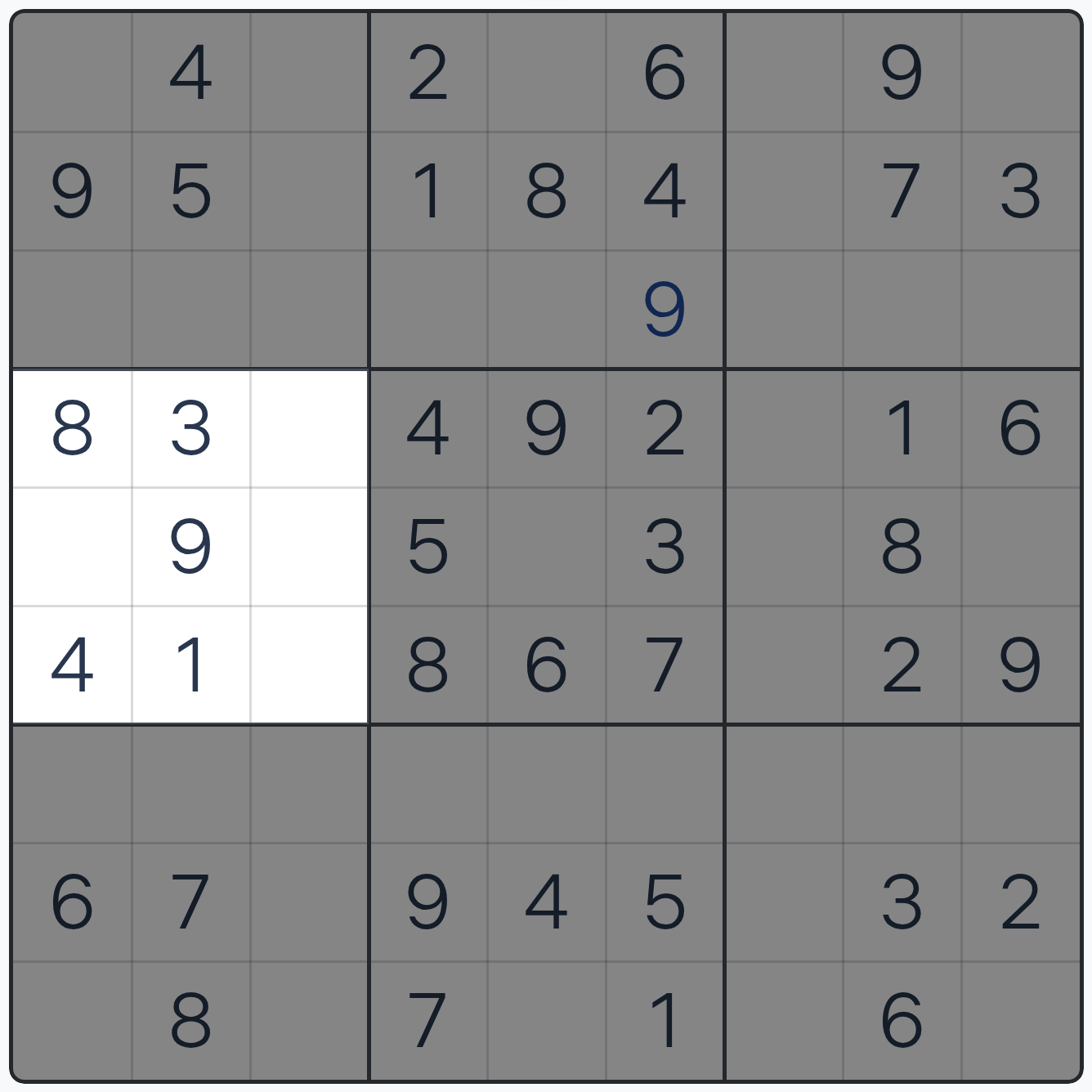
Look at the highlighted box. Four cells are empty, and the missing numbers are 2, 5, 6 and 7. At first glance, there is no obvious reason to choose one empty square over another. Instead of asking what belongs in each cell, take one missing number and ask where it is allowed to go.
Look particularly at the number 6. Can it go in the first empty cell? What about the others?
Show the answer
The 6 goes in row 5, column 3 (the middle cell of the box’s right-hand column).
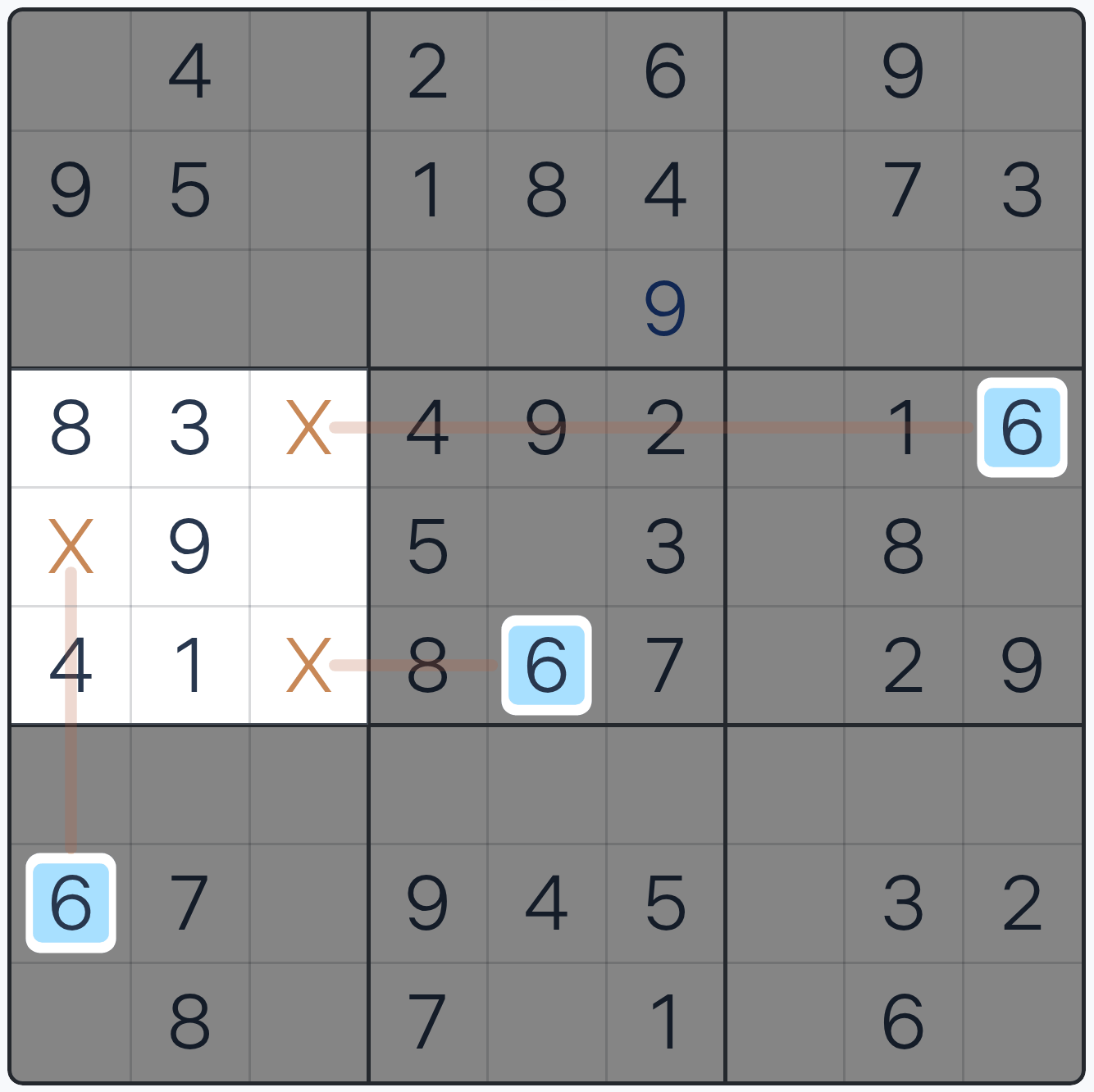
The 6 at the end of row 4 rules out the empty cell in row 4. The 6 in the middle of row 6 rules out the empty cell in row 6. The 6 lower down in column 1 rules out the empty cell in column 1. That leaves only one place for the 6.
You can practise this technique on many more positions with the free Sudoked hidden single trainer.
When you return to your own Sudoku, try repeating this process whenever a row, column or box looks stubborn. Pick one missing digit, check the possible places, and resist the temptation to work out every candidate at once. Sometimes the answer is already there; it is simply easier to see when you look for a place rather than a number.