Today’s post comes from the team at ManyPlay, who make free puzzle games you can play in your browser. They built a brand-new grid just for this article, one that needs every check below to crack it. Mr. Puzzle worked through every step, and it holds up.
Every sudoku player knows the moment. The easy cells are in, the grid is half done, and nothing seems to move. The temptation is to pick a cell, try a digit and hope.
Before you do, run five checks, in this order. They go from cheapest to most expensive, and very often one of them hands you the next move. We’ll walk through all five on one grid made for this article. Solved simplest-check-first, it needs every one of them.
A word on names: r3c1 means row 3, column 1, counting from the top left. Boxes are numbered 1 to 9 in reading order, so box 1 is top left and box 9 is bottom right.
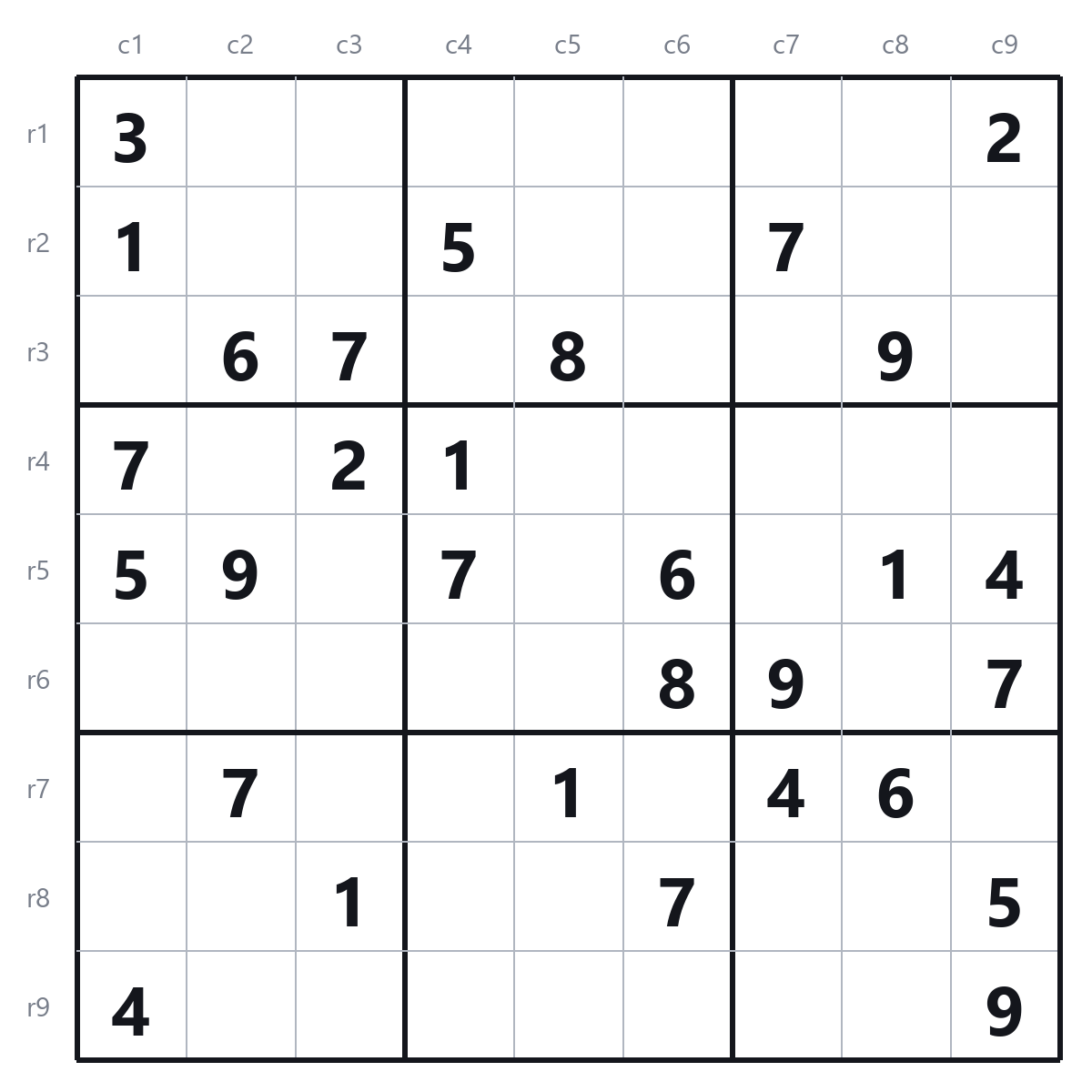
Check 1: Naked Singles
What to look for: a cell that can hold only one digit, because the other eight already appear in its row, column or box.
How to scan: start where things are crowded, with a cell whose row and column are both well filled. Count the different digits it can “see.” If you reach eight, the missing one is the answer.
In our grid: r3c1. Row 3 already has 6, 7, 8 and 9. Column 1 adds 1, 3, 4 and 5. Box 1 adds nothing new. The only digit left is 2.
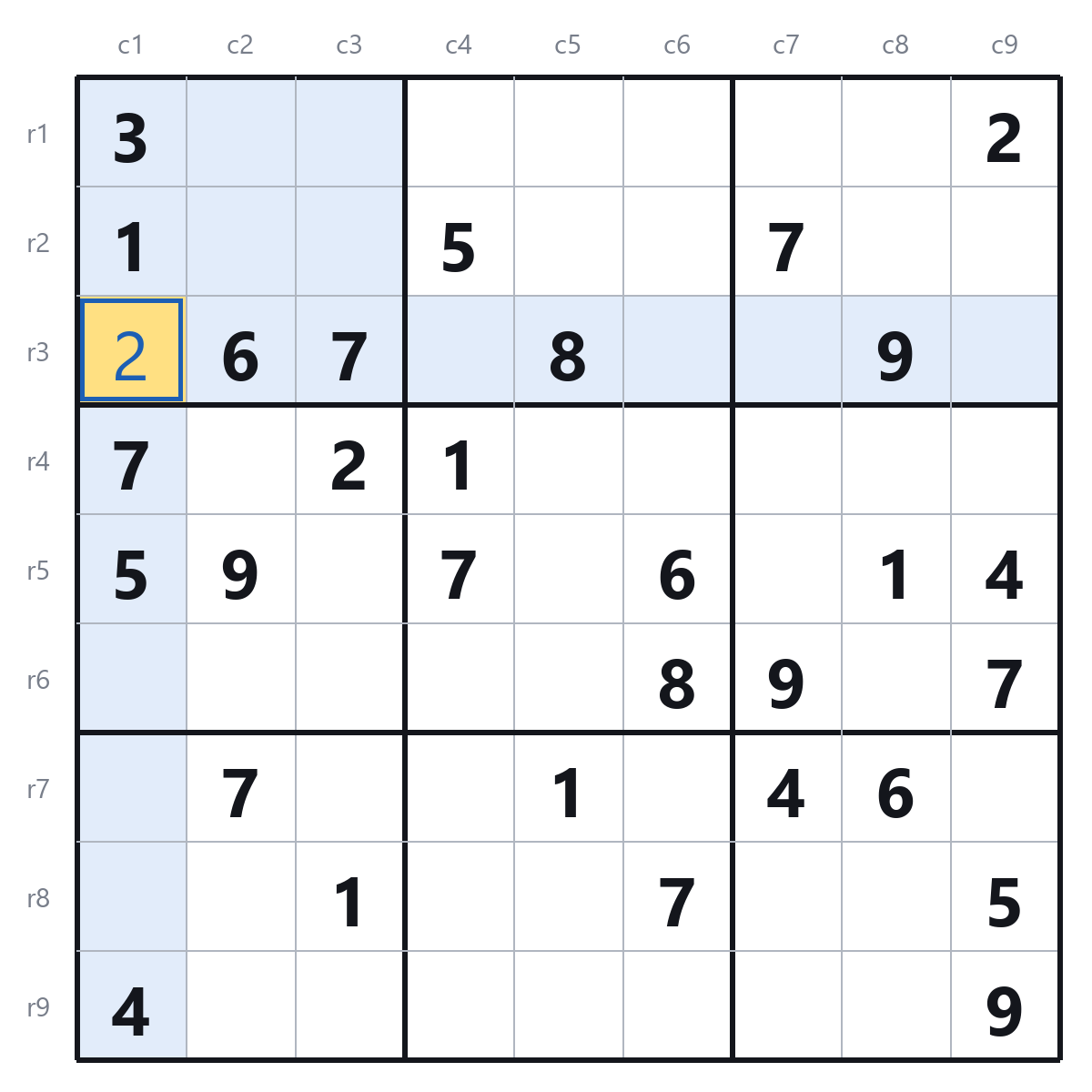
After every placement, look again at the cells around it. The same scan finds one more naked single at the start: r6c1, which can only be 6.
Check 2: Hidden Singles
What to look for: a digit with only one possible home in a row, column or box, even if that cell could still hold other digits.
How to scan: take one digit at a time. For each box missing it, follow every copy already placed along its row and column, and see which cells of the box it blocks. If only one cell survives, place the digit there.
In our grid: the naked singles run out after just two. So look at box 2 (top middle) and the digit 7. The 7 in r5c4 blocks column 4, the 7 in r8c6 blocks column 6, and the 7 in r2c7 blocks row 2. The only cell left in box 2 is r1c5, so it takes the 7.
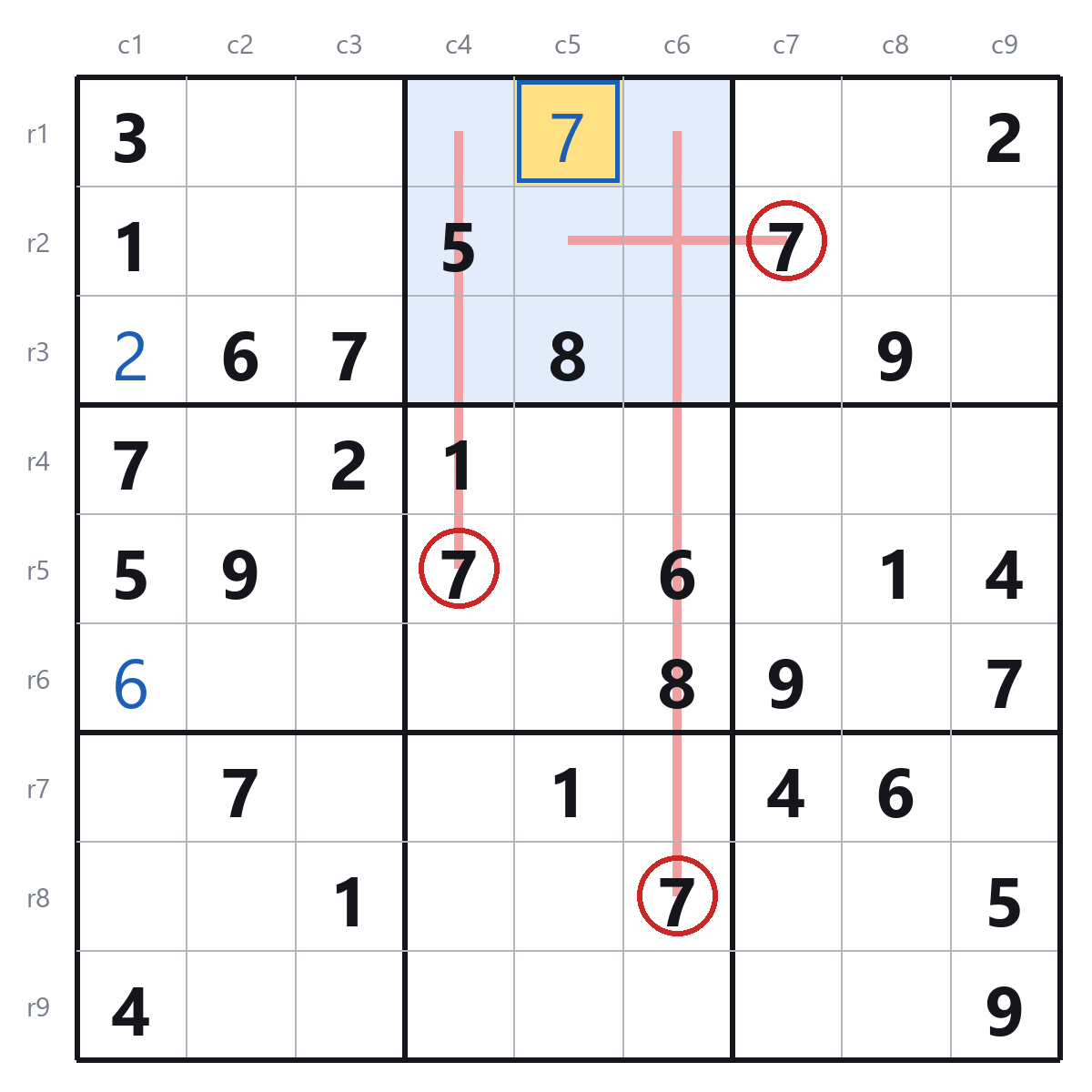
Hidden singles are easy to overlook, and they are often all you need. Here seven more follow, and then the grid goes quiet with 40 cells filled.
Before Check 3: Pencil Marks
From here on, write every digit still possible into every empty cell. Do it in one careful pass, digit by digit. A single wrong mark will make the next checks lie to you.
Check 3: Naked Pairs
What to look for: two cells in the same row, column or box with the same two candidates and nothing else. Those two digits must go into those two cells, in some order, so they can be crossed out everywhere else in that row, column or box.
How to scan: find cells with exactly two candidates, then check their row, column and box for a twin.
In our grid: r7c1 and r8c1 both hold only 8 and 9, and both sit in box 7. So 8 and 9 come out of the rest of box 7: both from r7c3, and the 8 from r8c2 and r9c2.
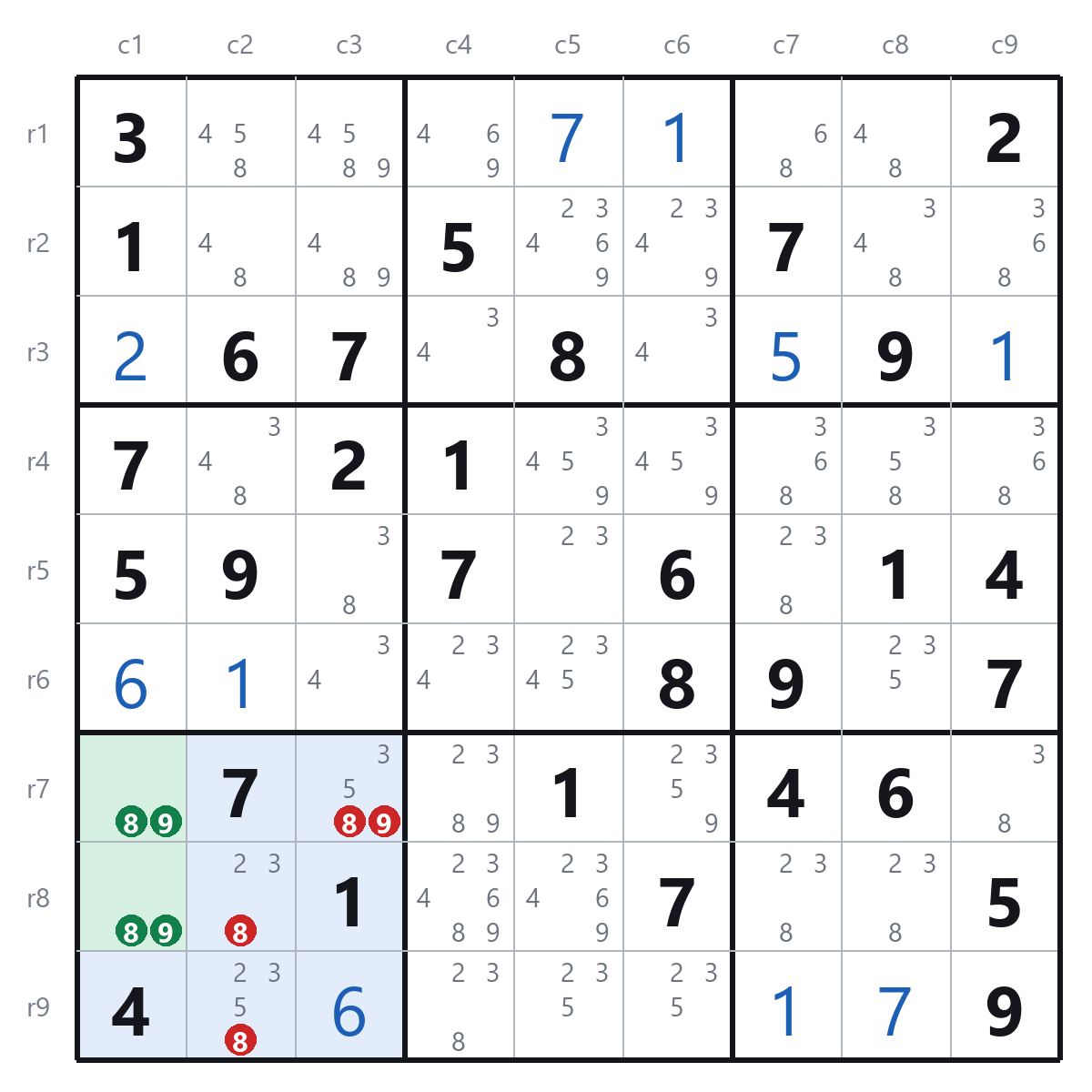
Now check what that unlocked. With the 8 gone from r9c2, r9c4 is the only cell in row 9 that can take an 8. A hidden single, straight out of a pair.
One more pair is waiting in box 2: r3c4 and r3c6, both 3 and 4. It tidies the box but places nothing, so on to check 4.
Check 4: Pointing Pairs
What to look for: inside one box, every candidate for a digit lies on the same row (or column). Wherever the digit lands in that box, it will be on that line, so it can’t go anywhere else on the line.
How to scan: go box by box, digit by digit, looking for candidates that line up, with none elsewhere in the box.
In our grid: in box 9, the only places for a 2 are r8c7 and r8c8, both in row 8. So 2 can be crossed out of the rest of row 8: r8c2, r8c4 and r8c5.
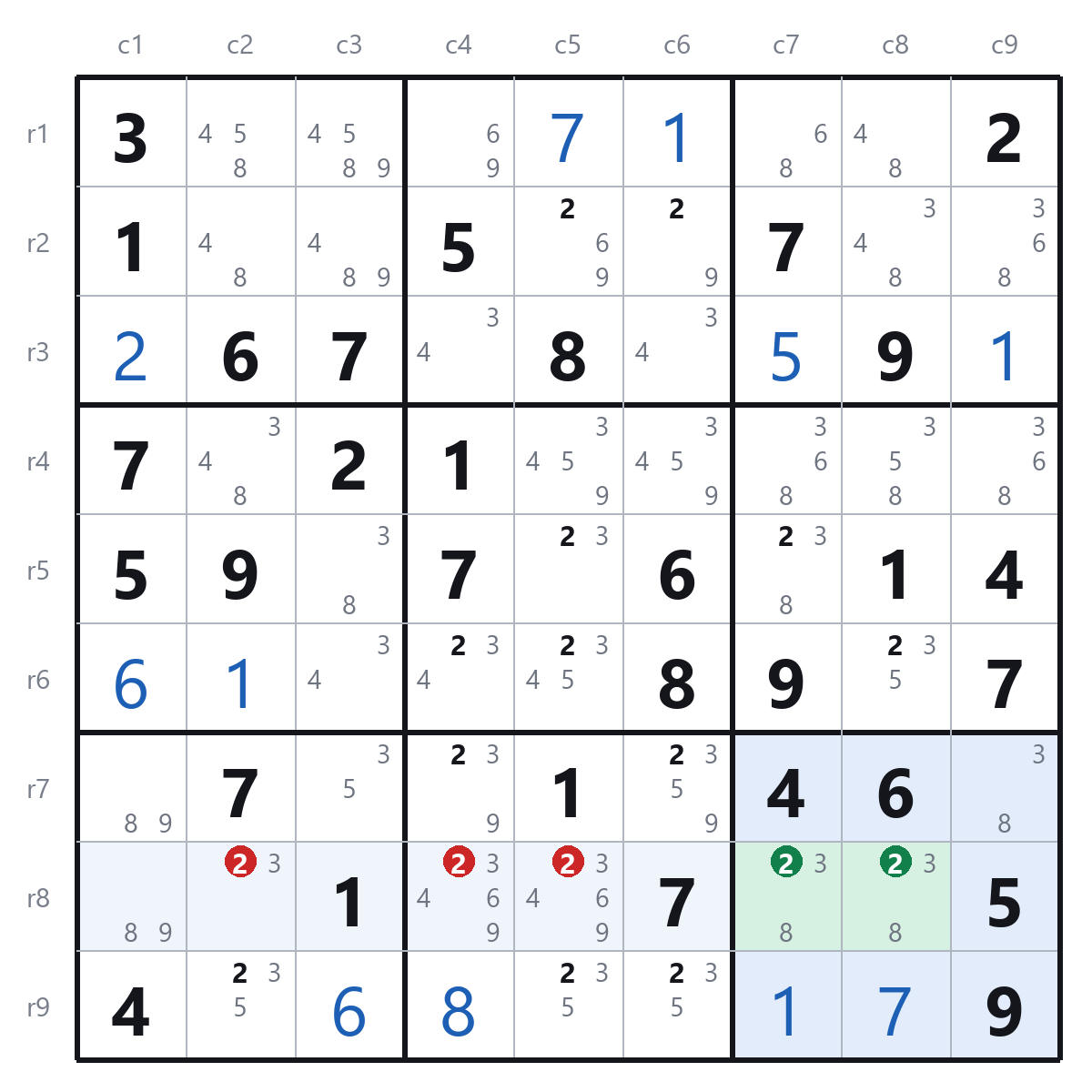
That leaves r8c2 with one candidate, 3, and the grid opens up again. Ten singles and one more naked pair, in column 6, take you to 51 filled cells.
The mirror version works too: if a row’s candidates for a digit all fall inside one box, clear that digit from the rest of the box.
Check 5: X-Wing
What to look for: a digit that appears exactly twice in each of two rows, in the same two columns. The four cells form a rectangle, and the digit must take two opposite corners. Either way, each of the two columns gets its copy, so the digit can be removed from the rest of both columns. It works with rows and columns swapped, too.
How to scan: pick a digit and count its candidates row by row. Note the rows where it appears just twice and compare their columns. It is slower than the other checks, which is why it comes last.
In our grid: at 51 cells, nothing from checks 1 to 4 works. Look at the 8s. In row 1 they are only in r1c3 and r1c7; in row 5, only in r5c3 and r5c7. Same two columns. So 8 comes out of the rest of columns 3 and 7: r2c3, r4c7 and r8c7.
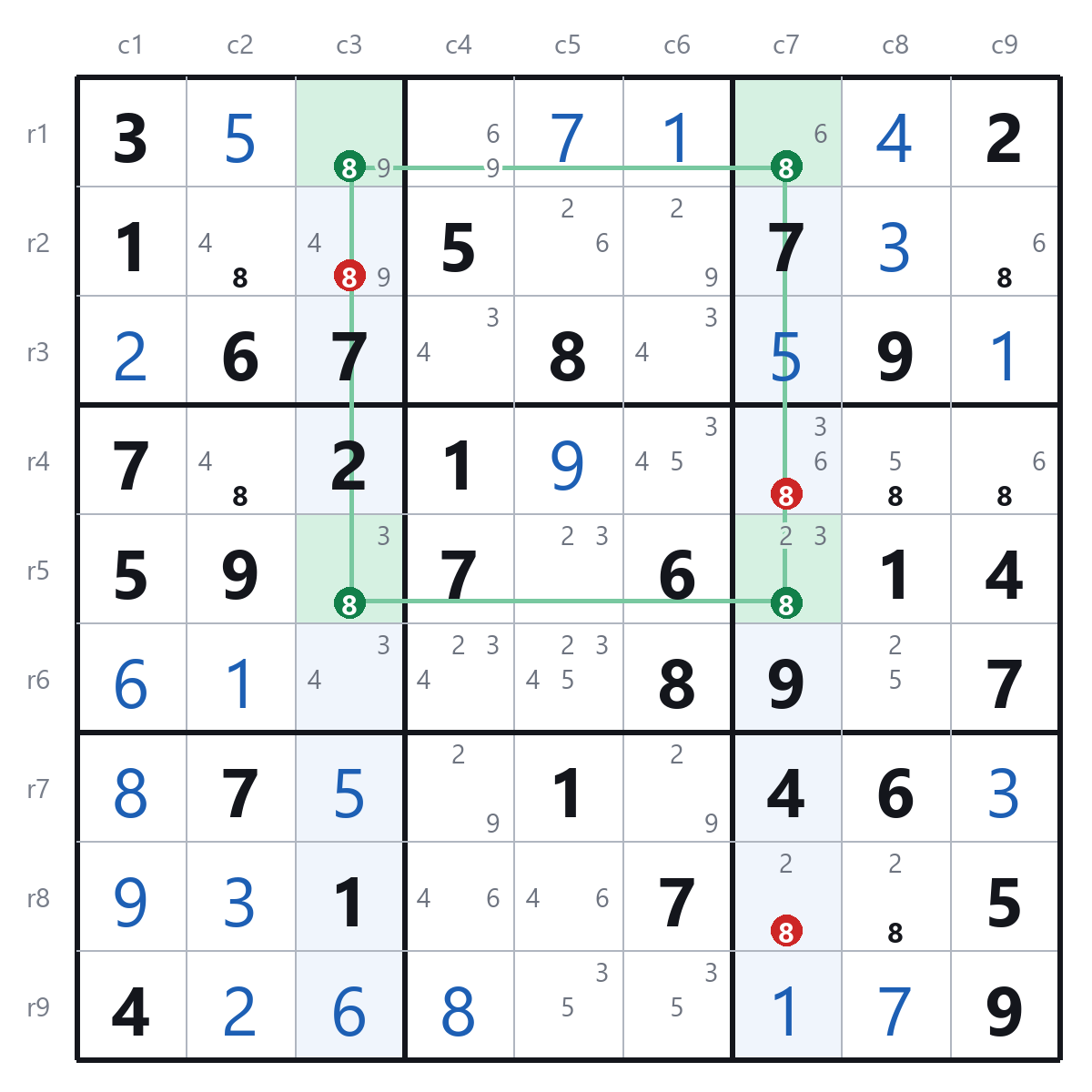
That was all the puzzle was waiting for. r8c7 is down to 2, which makes r8c8 an 8, and the last 30 cells fall to singles alone.
Only Now Consider Guessing
If all five checks come up empty, don’t guess yet. Recheck your pencil marks against the grid first. Many “impossible” positions turn out to be a missing mark, or one that should have been erased. Fix it and run the checks again.
If the grid is still stuck, the puzzle probably wants something heavier, such as hidden pairs, triples or chains. That is a fair moment to guess, as long as you do it carefully. Pick a cell with only two candidates, try one, and write everything that follows in a different colour. If you hit a contradiction, erase that colour: the other candidate is right, and you have learned something real about the grid instead of flipping a coin.